 Ultimate guide
Luxury Bathroom Remodel Cost 2026: What to Expect
Table of Contents
- What Drives the Average Luxury Bathroom Remodel Cost in 2026
- A Transparent Bathroom Remodel Cost Breakdown
- Luxury Bathroom Materials and What They Add to the Bill
- How to Set a Realistic Bathroom Remodel Budget
- The Bathroom Renovation Timeline From Demo to Final Walkthrough
- How to Compare Contractor Estimates Before You Sign
- Frequently Asked Questions
Last Updated: October 22, 2026
What Drives the Average Luxury Bathroom Remodel Cost in 2026
The average luxury bathroom remodel cost in 2026 is driven by four forces: project scope, material grade, labor rates, and the condition behind the walls.
Luxury is a spectrum, not a price tag. The U.S. Department of Housing and Urban Development tracks renovation activity across the country, and the pattern holds: scope and finish grade, not square footage alone, separate a mid-range remodel from a luxury one.
Most cost guides quote a single national average and stop there. That number is nearly useless without knowing what's included. A luxury bathroom remodel cost depends on whether you're moving plumbing, adding heated flooring, or replacing a builder-grade vanity with custom millwork.
A Transparent Bathroom Remodel Cost Breakdown
A bathroom remodel cost breakdown divides into five buckets: demolition and prep, rough-in trades (plumbing and electrical), surfaces and finishes, fixtures, and labor.
Luxury projects shift the balance toward materials. In a standard remodel, labor and materials run roughly even. In a high-end build, premium stone, custom cabinetry, and specialty tile can pull materials well ahead of labor. That's why two bathrooms of identical size can land in completely different budget tiers.
Where the Money Goes: Labor vs. Materials
Labor covers skilled trades: plumbers, electricians, tile setters, drywall finishers, and painters. Materials cover the tile, stone, fixtures, cabinetry, and lighting you see and touch.
The materials share climbs when you specify natural stone, a freestanding tub, or custom vanities. Our advice: decide your material grade first, then let the layout follow. It's far cheaper to design around existing plumbing than to relocate it for a tile pattern you love.
| Cost Bucket | What It Covers | What Pushes It Higher |
|---|---|---|
| Demolition and prep | Tear-out, hauling, subfloor repair | Hidden water damage, asbestos in old flooring |
| Plumbing and electrical | Rough-in, relocation, new circuits | Layout changes, heated flooring, added lighting |
| Surfaces and finishes | Tile, stone, drywall, paint | Natural stone, large-format tile, specialty patterns |
| Fixtures | Tub, shower, vanity, toilet, faucets | Freestanding tubs, walk-in showers, premium brands |
| Labor | Skilled trade hours | Complex layouts, tight spaces, high ceilings |
Itemized Luxury Budget: What a High-End Number Actually Buys
A single national average hides the real story. The most useful way to read a luxury bathroom remodel cost is a sample itemized budget for a same-layout primary bathroom renovation, no plumbing relocation, no structural changes, so you can see how dollars split between labor, materials, fixtures, and contingency.
| Line Item | Planning Allowance | Notes |
|---|---|---|
| Demolition, hauling, and disposal | $2,500-$5,000 | Rises with tile removal, cast-iron tubs, and difficult access |
| Plumbing rough-in (same layout) | $3,000-$6,000 | Relocation, new drains, or a freestanding filler push this higher |
| Electrical rough-in and lighting | $2,000-$5,000 | Heated flooring, added circuits, and layered lighting add cost |
| Waterproofing and substrate prep | $1,500-$4,000 | Curbless showers and steam showers require more |
| Tile and stone (material plus install) | $8,000-$25,000+ | Large-format, book-matched, and natural stone sit at the top |
| Custom cabinetry and vanity | $5,000-$15,000+ | Stock vs. semi-custom vs. full custom is the biggest lever |
| Fixtures (tub, shower, toilet, faucets) | $4,000-$15,000+ | Freestanding tubs and premium brands drive the upper end |
| Countertops and fabrication | $2,000-$6,000 | Quartz and quartzite carry fabrication and waste premiums |
| Paint, trim, and finish carpentry | $1,500-$4,000 | More millwork means more labor |
| Permits and inspections | $500-$2,500 | Varies by jurisdiction and scope of trade work |
| Contingency (10-20%) | 10-20% of hard costs | See the budget section below for how to size it |
Read the table as a set of dials, not a fixed recipe. Keep the existing layout, choose porcelain tile that reads like stone, and select semi-custom cabinetry to land near the low end.
Luxury Cost Scenarios by Bathroom Size and Scope
Square footage alone doesn't set the price, but it's a useful anchor when you hold scope constant. The scenarios below compare like-for-like projects: same finish grade, same layout philosophy, different room size. They are planning ranges, not bids.
- Small luxury powder room (roughly 25-40 sq ft): Mostly finishes and fixtures, a statement vanity, a designer toilet, wallpaper or stone, and premium lighting. With no tub or shower, plumbing and waterproofing costs stay low. A cosmetic-to-moderate refresh often lands in the low five figures; a full gut with relocated plumbing can climb well into it.
- Standard primary bathroom (roughly 60-100 sq ft): The most common luxury scope: a curbless walk-in shower, a freestanding or built-in tub, a double vanity, and heated flooring. Keeping existing drain and supply locations holds the budget down; reconfiguring the shower or moving the toilet adds trade hours and inspection steps.
- Large primary bathroom (roughly 120-200+ sq ft): Larger rooms multiply tile, stone, and cabinetry costs even when the layout doesn't change, because every surface grows. Add a steam shower, a wet room, or a second vanity and the project moves into a different tier entirely.
A same-layout renovation and a full reconfiguration can differ by tens of thousands of dollars on identical square footage. The gap comes from plumbing relocation, new electrical circuits, structural work for a curbless shower or heavier tub, and extra inspection and scheduling time.
Luxury Bathroom Materials and What They Add to the Bill
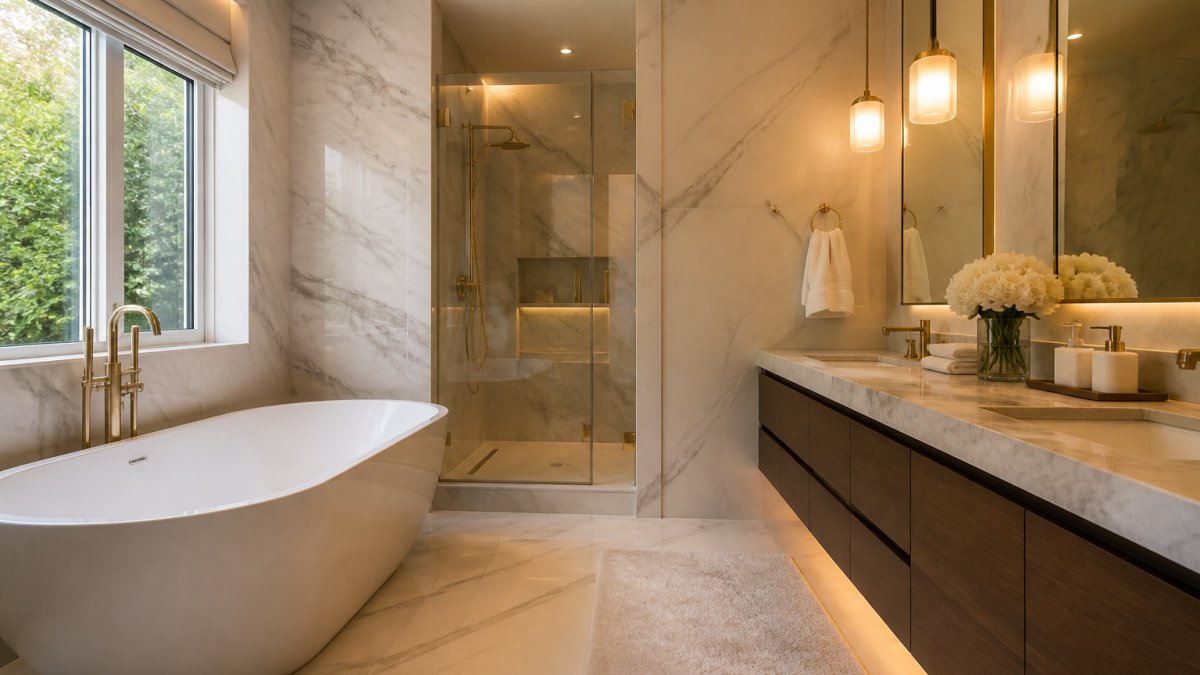
Luxury bathroom materials are where budgets stretch fastest. Natural stone, large-format tile, custom cabinetry, and premium fixtures each carry a material cost plus a labor premium, because they demand more skill and precise installation.
Stone, Tile, and Custom Cabinetry Allowances
An allowance is a set dollar figure in your contract for a material you haven't picked yet. Set realistic allowances to avoid mid-project surprises; set them too low and every selection becomes a change order.
- Natural stone: Marble and quartzite raise both material and fabrication costs. Expect more waste on book-matched slabs.
- Large-format tile: Fewer grout lines, but heavier pieces and more prep work.
- Custom cabinetry: Built to your dimensions, which costs more than stock but fits oddly shaped rooms.
How to Set a Realistic Bathroom Remodel Budget
Setting a realistic bathroom remodel budget starts with three numbers: your total ceiling, your contingency, and your allowance pool. Work backward from the ceiling, not forward from wish-list items.
Start with what you can spend, subtract a contingency, then allocate the remainder across the five cost buckets. This forces honest trade-offs early, when they're painless. A useful sequence:
- Set the ceiling. Decide the maximum you will spend, including contingency, permits, and any temporary housing or logistics costs.
- Carve out contingency. Reserve a percentage of hard costs before allocating anything else. Most practitioners size it at 10-15% for a same-layout renovation and 15-20% for a full reconfiguration or an older home where the condition behind the walls is unknown.
- Build the allowance pool. Decide what you'll spend on tile, stone, cabinetry, fixtures, and lighting, the selections you haven't made yet. Quote allowances as ranges so you know what "standard" versus "upgraded" actually costs.
- Allocate the remainder to labor and trades. Plumbing, electrical, waterproofing, and installation labor are largely fixed by scope, not taste, so size them after the selections are bounded.
- Hold a decision reserve. Keep a small unallocated cushion for selections you change your mind about after demo. It's cheaper than a change order.
Contingency, Hidden Damage, and Change Orders
Contingency is money set aside for what demolition reveals. Older homes hide surprises: compromised subfloor, outdated wiring, corroded supply lines, and failed waterproofing from a previous remodel. A healthy contingency keeps those discoveries from derailing the project.
The most common hidden-damage items in a luxury bathroom remodel, and why they matter:
- Water damage and rot. A slow leak behind tile or around a tub can soften subfloor and framing. Repair means new substrate, new framing, and sometimes mold remediation, costs that appear only after demo.
- Outdated wiring. Older bathrooms often lack the circuits a luxury build needs for heated flooring, a steam shower, or layered lighting. Adding circuits means an electrician, a permit, and an inspection.
- Corroded or undersized plumbing. Galvanized supply lines and cast-iron drains may need replacement once the walls are open, especially if you're adding a freestanding tub or a larger shower.
Change orders are formal, priced adjustments to the original contract. They're not inherently bad, but they should be rare and documented. Signing them every week means the original scope was incomplete.
How Allowances and Contingency Interact
Allowances and contingency solve different problems, and confusing them is a common budgeting error. An allowance is a placeholder for a selection you haven't made, tile, stone, cabinetry, fixtures. Contingency is a reserve for conditions you can't see until demo.
A practical pattern: set allowances as ranges with a stated "standard" and "upgraded" figure, then ask your contractor to show how each selection lands against the range.
The Bathroom Renovation Timeline From Demo to Final Walkthrough
A bathroom renovation timeline usually runs from demo through rough-in, inspections, waterproofing, tile, fixtures, and final walkthrough. The sequence matters more than the calendar: each phase depends on the one before it.
- Demolition and inspection: Tear-out and a look at what's behind the walls.
- Rough-in: Plumbing and electrical, followed by municipal inspections.
- Waterproofing: The step that protects everything above it.
Timelines slip when selections are late or hidden damage appears. Lock in materials before demo starts and the schedule has a fighting chance.
How to Compare Contractor Estimates Before You Sign
Comparing contractor estimates means reading past the bottom line. Two quotes for the same bathroom can differ because one excludes waterproofing, permits, or debris hauling. Line-by-line comparison exposes what's missing.
Look for a written scope, itemized allowances, a stated contingency, a payment schedule tied to milestones, and proof of licensing and insurance. Ask who pulls the permits and handles inspections.
At Bella's Multi Services LLC, we put scope, allowances, and contingency in writing before work begins, so the number you approve is the number you plan around. Call for a free estimate and we'll walk you through a line-item budget built for your bathroom.
Frequently Asked Questions
How much does a luxury bathroom remodel usually cost?
A luxury bathroom remodel typically runs well above a standard renovation because of premium materials, custom cabinetry, and layout changes. The final luxury bathroom remodel cost depends on square footage, whether plumbing or electrical is relocated, and the finishes you select. Rather than quoting a single figure, ask contractors for an itemized estimate that separates labor, materials, permits, and contingency. Bella's Multi Services LLC provides free estimates so you can see a line-by-line breakdown before committing to a bathroom remodel budget.
What factors have the biggest impact on luxury bathroom remodel costs?
Layout changes are the largest driver, since moving plumbing or electrical adds labor and permit work. Next come luxury bathroom materials: natural stone, custom cabinetry, freestanding tubs, and heated flooring all raise the total. Bathroom size matters too, since more square footage means more tile, drywall, and labor hours. Finally, regional labor rates and the condition of what's behind the walls affect the bathroom remodel cost breakdown. Get an itemized estimate so you can see exactly which factors apply to your project.
How long does a luxury bathroom remodel take?
A typical bathroom renovation timeline runs several weeks for a full-scale renovation, with luxury projects often taking longer due to custom fabrication and special-order materials. Demolition and rough-in work come first, then inspections, drywall, tile, and fixture installation. Custom cabinetry and natural stone can add lead time. Ask your contractor for a written schedule with milestones, and confirm material delivery dates early so the bathroom renovation timeline doesn't slip.
How do I budget for unexpected costs during a luxury bathroom renovation?
Set aside a contingency fund of roughly 10 to 20 percent of your total bathroom remodel budget. Older homes often hide damaged subfloor, outdated wiring, or corroded plumbing once demolition begins. A written change-order process protects you: no extra work should start without your signed approval and a clear price. Ask upfront how your contractor handles hidden damage and who pays for it. Bella's Multi Services LLC documents conditions as walls open so surprises are handled transparently, not billed silently.
A luxury bathroom is a major investment, and the difference between a smooth project and a stressful one usually comes down to planning and a contractor who documents everything. Bella's Multi Services LLC handles luxury bathroom and kitchen remodeling with personalized design, high-end materials, professional drywall, tile, and painting, and seamless project management from first measurement to final walkthrough. Call for a free estimate and get a transparent, itemized budget before you commit.