 How-to
Hiring Professional Painters for High Ceilings: What to Know
Last Updated: October 30, 2026
Quick Summary
Hiring professional painters for high ceilings is the safer, faster route to a clean finish when walls climb past the reach of a standard stepladder. Painters reach high ceilings with rolling scaffolding, extension poles, and ladders rated for the load, matching the platform to ceiling height and room shape. Ceilings above roughly 10 feet, vaulted slopes, two-story foyers, and stairwells usually call for a pro.
- Most ceiling injuries come from the setup, not the paint, so ladder placement matters most.
- Rolling scaffolds suit flat or gently sloped ceilings roughly 10 to 16 feet high.
- Extension poles work for flat ceilings up to about 12 feet but reduce control as they lengthen.
- Angi puts professional ceiling painting between $200 and $500 on average for residential work.
- Ask whether the quote is fixed and whether scaffolding or lift rental is included.
Table of Contents
- Why High Ceilings Need Professional Painters
- How Painters Reach High Ceilings Safely
- The Cost to Paint High Ceilings
- Choosing the Best Paint for High Ceilings
- Surface Preparation and Stain Blocking on Ceilings
- Questions to Ask a Painting Contractor Before You Hire
- Requesting a Free Estimate from Bella's Multi Services
- Frequently Asked Questions
Why High Ceilings Need Professional Painters
Hiring professional painters for high ceilings is the safer, faster route to a clean finish when walls climb past the reach of a standard stepladder. The work looks similar to ordinary painting from the floor. Up close, it is a different job with different risks.
Height changes how these projects go, from the tools and prep to the paint choice and the time it takes.
The U.S. Bureau of Labor Statistics counts roughly 342,200 painters nationwide, and the Occupational Outlook Handbook projects 3 percent growth from 2025 to 2035. Steady demand, in other words, and a deep bench of people who do this for a living.
The Risks of DIY on Tall Walls and Ceilings
Most ceiling injuries come from the setup, not the paint. A ladder placed on a drop cloth, a roller extended past comfortable reach, a stretch backward at the top of a step stool. Each one is a fall waiting to happen.
A common mistake is treating a vaulted ceiling like a tall wall. It is not. You cannot see the lap marks from the floor, you cannot reach the far slope without moving the platform, and you cannot control drips overhead. Watch out: paint sprayed from an extension pole at full height lands on floors, furniture, and you.
What Professional Results Actually Look Like
Even coverage is the visible difference. No roller ridges catching the light, no darker bands where a pass overlapped, no bleed-through from an old stain. Flat finishes hide imperfections; they also show every lap mark if the application is sloppy.
How Painters Reach High Ceilings Safely
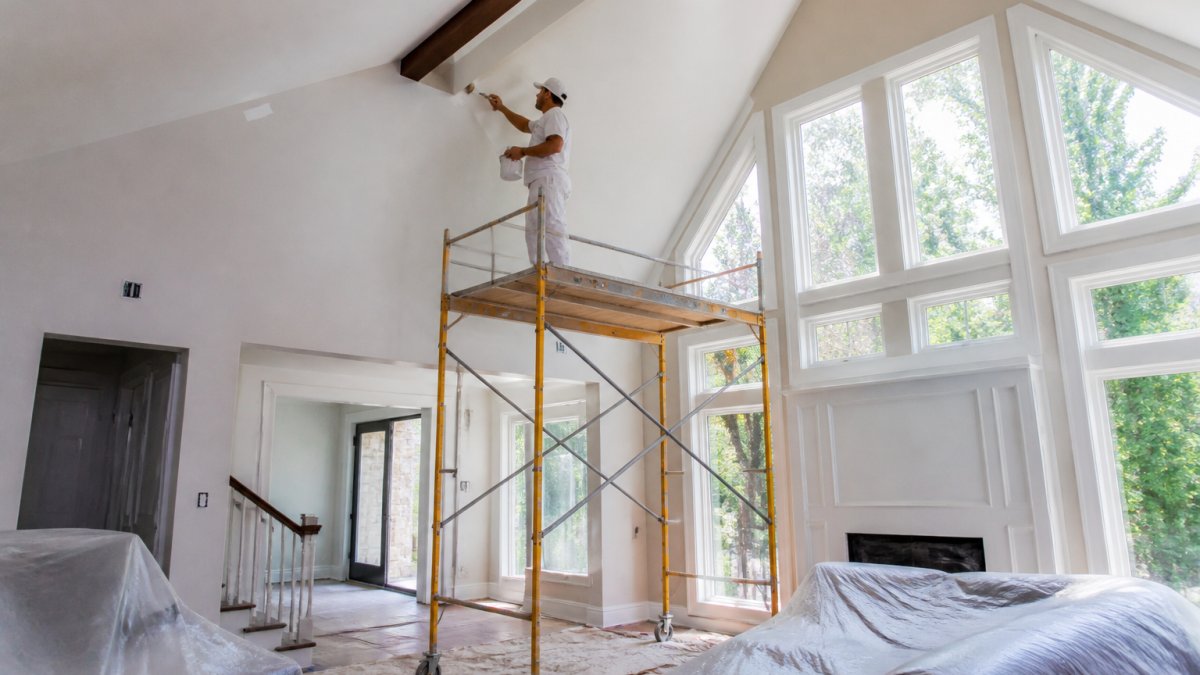
Painters reach high ceilings with a mix of rolling scaffolding, extension poles, and ladders rated for the load. The right tool depends on ceiling height, room shape, and how much cutting in the edges require. Most of the safety difference between a smooth job and a dangerous one comes down to matching the platform to the room, not to how brave the painter is.
Scaffolding, Extension Poles, and Ladder Safety
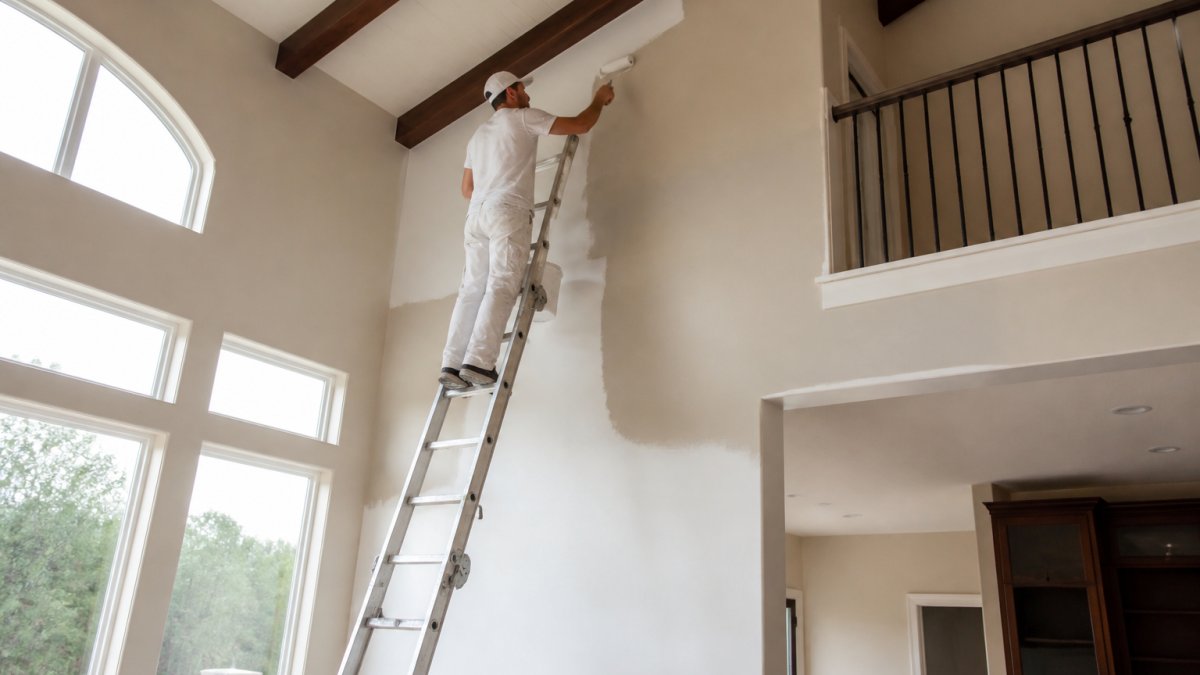
Scaffolding gives a stable platform for cathedral ceilings and two-story foyers. Extension poles add reach from the floor, which suits flat ceilings up to a point. Ladders fill the gaps for cut-in work along walls and corners.
Here is how the equipment actually breaks down by job:
- Rolling scaffold (baker-style or frame): Best for flat or gently sloped ceilings roughly 10 to 16 feet high where the crew needs to move laterally along the ceiling. It keeps both hands free for cut-in and rolling, and it eliminates the repeated climb-and-descend that causes most ladder fatigue. Trade-off: it needs clear floor space and takes time to assemble and reposition around furniture.
- Extension poles (4 to 12 feet): Good for flat ceilings up to about 12 feet when the surface is open and the painter can stand back from the wall. Trade-off: control drops as the pole lengthens, so lap marks and drips become more likely, and poles are poor for cutting in edges or working around beams.
- Articulating or multi-position ladders: Useful for stairwells, sloped ceilings, and tight corners where a scaffold will not fit. Trade-off: the painter works one section at a time and must descend to move, which slows the job and increases fatigue on long ceilings.
- Aerial lifts (scissor or boom): Reserved for commercial spaces, two-story great rooms, and ceilings above roughly 16 feet where no scaffold or ladder is practical. Trade-off: rental cost, floor protection, and the need for trained operators.
Ladder safety is not optional. Every ladder gets set on firm, level ground, locked open, and held to the three-point contact rule. Falls from ladders are a common source of home injuries, which is why the setup matters more than the paint. Drop cloths go down before anything goes up. Masking protects trim and fixtures. Clean crews work in stages so nothing is left half-covered overnight.
When a Ceiling Is Too High or Complex for DIY
A useful rule of thumb: if the ceiling cannot be reached safely from a stepladder while both feet stay on the same step and the painter never has to lean or stretch, it is probably a pro job. Navigating these complex architectural heights requires a careful evaluation of safe access methods to determine whether rope systems or traditional scaffolding provide the most stable foundation for the work.
The reasons are practical, not just cautious. Extension-pole work from the floor is hard to control at height, and a homeowner stretching backward at the top of a ladder is the classic fall scenario. Overhead paint also drips differently than wall paint: it lands on faces, floors, and furniture, and it is far harder to control when the painter is working one-handed.
The Cost to Paint High Ceilings
What you pay depends on ceiling height, square footage, surface condition, and access. Angi puts professional ceiling painting between $200 and $500 on average for residential work, with the total driven by ceiling size and height. Faro's Construction Services estimates $1 to $3 per square foot for ceiling projects. Interior painting overall runs $2 to $6 per square foot for walls, rising to $4.70 to $6.75 once trim and ceilings are included, according to Facade Colorizer's 2026 cost guide.
Pricing depends on ceiling height, access, and the condition of the surfaces. Contact Bella's Multi Services LLC for current pricing or a quote.
| Cost Factor | What Drives It | Effect on Price |
|---|---|---|
| Ceiling height | Scaffolding, lift rental, extra labor time | Higher |
| Square footage | Paint volume, labor hours | Higher |
| Surface condition | Drywall repair, sanding, stain blocking | Higher |
| Architectural detail | Vaulted slopes, beams, trim, recessed lights | Higher |
| Access | Furniture moving, masking, floor protection | Moderate |
| Texture removal | Scraping, skim coating, disposal | Higher |
Why High Ceilings Cost More Per Square Foot
A common pattern is that the per-square-foot price rises with height even when the ceiling area is small, because the fixed cost of access is spread over fewer square feet. A two-story foyer of 200 square feet can cost more per square foot than a 600-square-foot flat ceiling in a single-story room.
How to Read a High-Ceiling Painting Quote
Ask for the quote to separate labor, materials, prep, and access equipment. A fixed quote should state what is included: drywall repair, stain-blocking primer, paint brand and sheen, floor and furniture protection, and cleanup. Watch for quotes that exclude scaffolding or lift rental, since that line item can change the total significantly. If the quote is hourly rather than fixed, ask for an estimated range and the conditions that would push it higher.
Choosing the Best Paint for High Ceilings
The best paint for high ceilings is a flat or matte finish in a quality brand, applied over a stain-blocking primer. Flat sheen hides roller marks and minor drywall flaws that a semi-gloss would highlight under raking light.
Professional painters tend to reach for established manufacturers like Benjamin Moore or Sherwin Williams, a preference that shows up repeatedly in homeowner discussions on Reddit. Low-VOC paint matters more in a closed room with limited airflow, and it dries fast enough to keep a schedule moving. Color consultation helps here too: a shade that reads warm at eye level can look cold 12 feet up.
Surface Preparation and Stain Blocking on Ceilings
Stain blocking comes next. Water stains, smoke marks, and old water damage bleed through ordinary paint, sometimes within days. A shellac- or oil-based primer seals the stain so the topcoat stays even. Cut-in techniques along the wall line keep the edge sharp, and roller extension work fills the field without lap marks.
Questions to Ask a Painting Contractor Before You Hire
Ask about licensing, insurance, and whether the quote is fixed before anyone picks up a brush. A contractor who hesitates on any of those three is a contractor to skip.
Here is the checklist we would want a homeowner to run through:
- Are you licensed and insured, and can I see proof?
- Is this a fixed quote, or can the price change mid-project?
- Who handles drywall repair and stain blocking, and is that included?
- What paint brand and sheen do you recommend, and why?
- How do you protect floors and furniture?
- Can I call two recent references?
- What is the start date and completion window?
A fixed quote protects you from the surprise-cost stories that make homeowners nervous. References you can actually call tell you more than any portfolio photo. Ask specifically about high-ceiling jobs, since not every crew takes them on.
Requesting a Free Estimate from Bella's Multi Services
High ceilings are where a renovation either looks seamless or shows every shortcut. We would rather you see the plan before you commit. Bella's Multi Services LLC offers comprehensive renovation services, including drywall, tile, and painting.
Bella's Multi Services LLC uses high-end materials and provides personalized design and seamless project management. Contact us for current details on our process.
Call Bella's Multi Services LLC for a free estimate and get a clear scope, a set price,
Frequently Asked Questions
How much does it cost to paint a room with high ceilings?
Pricing depends on ceiling height, square footage, surface condition, and access. Contact Bella's Multi Services LLC for current pricing or a quote.
Do painters need scaffolding to paint high ceilings?
Ask your contractor how they plan to reach your ceiling height and what safety equipment they will bring.
What should I ask a painting contractor before hiring them?
Ask whether they are licensed and insured, how they handle surface preparation and stain blocking, and how they protect floors and furniture with drop cloths and masking. Request references from high-ceiling projects and confirm the quote is fixed rather than hourly. Also ask who handles drywall repair if cracks or water damage appear.
What is the best paint for high ceilings?
A flat finish in a low-VOC paint is the standard choice for ceilings because it hides imperfections and reduces glare from tall windows. Flat paint also touches up easily, which matters on large ceiling spans. Professional painters typically use high-quality products from established manufacturers, and a stain-blocking primer prevents bleed-through from water marks. Bella's Multi Services uses high-end materials to deliver a durable, even finish.
The gap between a ceiling that looks painted and one that looks finished comes down to prep, tools, and who is holding the roller. If your room has height, angles, or old stains, let us take a look. Bella's Multi Services LLC offers fixed quotes, high-end materials, and full project management from first walkthrough to final coat. Get started with Bella's Multi Services LLC and request your free estimate today.